 Stromboli Volcano Tours
Stromboli Volcano Eruption: the Current Status
Stromboli volcano eruption status changes by the week, and this page reads the official monitoring so you know which kind of erupting the volcano is doing. Stromboli volcano has been erupting in the same mild way for centuries, and the question is never really whether it is erupting but how strongly. This page reads the official monitoring, explains what ordinary Strombolian activity means, and sets out what the volcano's history changes for anyone planning a tour. The island sits about 55 km north of Sicily at Milazzo, has roughly 580 residents, and its volcano has earned the word Strombolian a place in the volcanological dictionary. The practical conclusion, stated up front, is that tours run in ordinary activity and the monitoring decides the rest.
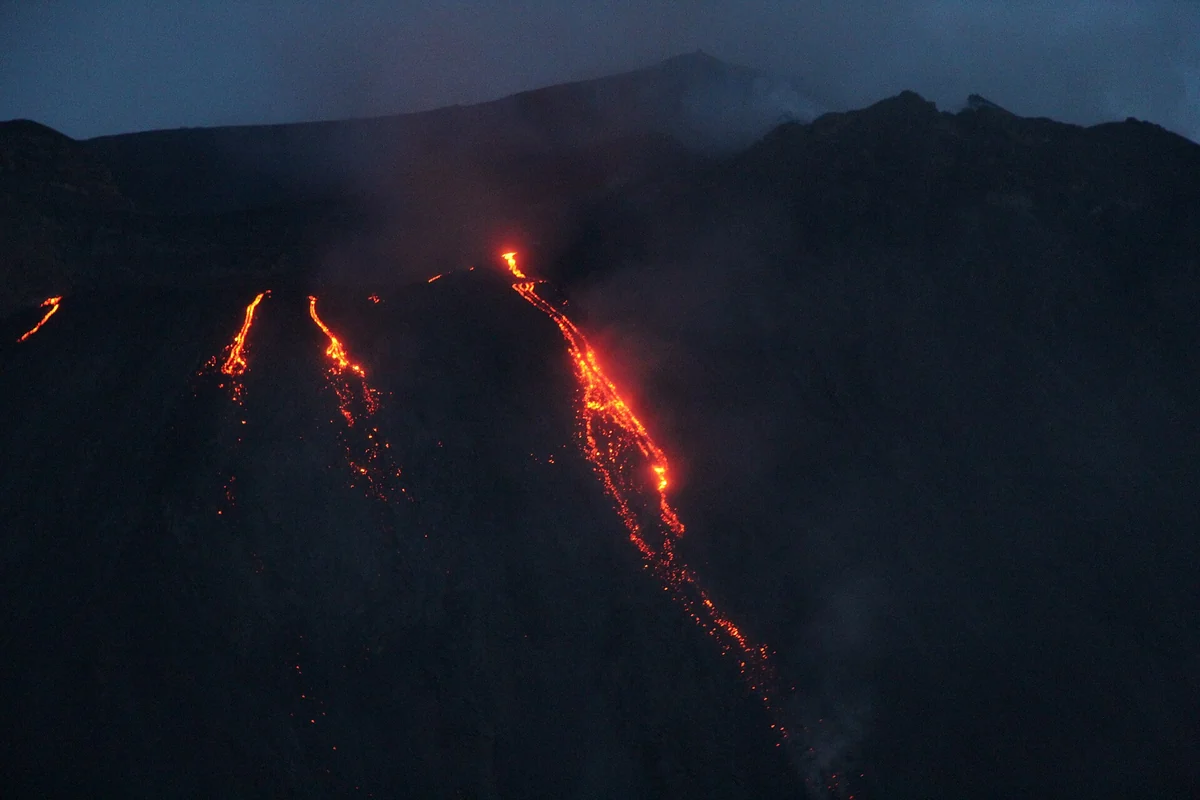
An effusive phase in October 2014: lava moving down the Sciara. Photo: GerritR, CC BY-SA 4.0, via Wikimedia Commons
Quick answer Yes, and that is normal. INGV Osservatorio Etneo weekly bulletins recorded ordinary Strombolian activity from ...
Yes, and that is normal. INGV Osservatorio Etneo weekly bulletins recorded ordinary Strombolian activity from both crater areas through September 2026, with moderate-to-high degassing and explosions ongoing in the second week of that month. No elevated alert was in force on the checked dates. Ordinary Strombolian activity means small gas explosions at the crater rims, several an hour, visible as glow and bursts after dark. This has been the volcano's near-continuous state for centuries, which is why the activity style carries the volcano's own name. Rare larger explosions called paroxysms happened in July and 2019 and in 2024. They are years apart, not a daily event, and each briefly raised the civil-protection alert level before it was stood down.
Key takeaways
- The volcano is in ordinary activity, the state it has held for centuries, and Stromboli volcano tours that run in ordinary activity are built around exactly this behaviour
- Check the latest bulletin from INGV monitoring and the civil-protection updates at Protezione Civile before you travel
- A clear evening almost always shows bursts, because the craters explode several times an hour. Weather, not the volcano, is the usual spoiler
- Above 400 m the mountain is closed, so no honest operator sells a true summit hike. Compare what you can actually book at compare current Stromboli tour prices
What Ordinary Strombolian Activity Actually Means
The word Strombolian comes from this island, so the baseline activity is not a warning sign. It is the reason people come.
The baseline state, in plain words
Ordinary Strombolian activity is a rhythm of small gas explosions at the crater rims, several every hour. Each burst throws incandescent fragments tens to hundreds of metres above the vents, glows red against the dark, and usually ends with a rumble that carries across the water. The craters sit on a terrace high on the volcano, out of sight from the villages, so what most visitors see is the glow and the spray of light above the Sciara del Fuoco.
That steep NW scree funnel, the channel of fire, directs erupted material down toward the sea, which is why boats can watch from a distance with a clear line of sight. Boats hold position 300 to 500 m off the Sciara after dusk, and most night cruises hold for about 30 minutes. From the guided viewpoint on the Sciara's eastern rim at 400 m, roughly 350 to 400 m in a straight line from the craters, you hear and feel the explosions as much as see them.
Access is tied to a civil-protection alert protocol with green, orange and red levels, and the mayor of Lipari's ordinances set the altitude limits under it, so after any escalation the rules in force change until a new ordinance resets them. The same activity reads differently from the trail: the full route brief for the volcano walk explains the 400 m vantage.
Why the naming matters for your booking
Because this mild explosive style has run near-continuously for centuries, a tour operator does not need luck to show you the volcano. The craters burst several times an hour, so a clear evening almost always shows something. What varies is the size of individual bursts, and no tour can guarantee a large one.
That honesty appears in the listings themselves: the good ones describe glow, bursts and crater glow reflected in the water rather than promising an eruption on cue. It also explains why cancellation for volcanic reasons is rare. In ordinary activity, the thing that most often ruins an evening is cloud, wind on the return crossing or a rough sea, not a change in the volcano.
The guided requirement on the upper slopes is law, written in the Mayor of Lipari's ordinance, and it exists because the volcano is genuinely active every single night, not because it occasionally misbehaves.
What INGV's Bulletins Say, and How to Read Them
Stromboli is monitored around the clock. The bulletins are public, and they are the only status source worth trusting.
The current picture
The weekly bulletins from INGV Osservatorio Etneo recorded ordinary Strombolian activity from both crater areas through September 2026, with explosions ongoing in the week of 7 to 13 September and moderate-to-high degassing. No elevated alert was in force on the checked dates. That is the entire status in one sentence, and it matches the volcano's centuries-long baseline.
The bulletins are published at INGV monitoring, and they describe crater areas, explosion frequency, degassing and any anomalies in plain technical language. If the bulletin says ordinary Strombolian activity, every tour on the island is operating as normal.
Reading the alert levels
Alongside the scientific bulletins sits a civil-protection alert protocol, published through Protezione Civile. When a paroxysm occurs, the alert level is raised briefly and then lowered as monitoring returns to baseline, which is what happened after both the 2019 and the 2024 events. For a traveller the translation is simple.
Ordinary bulletin, ordinary activity, ordinary rules, tours sail and treks climb as scheduled. Elevated alert, the guided treks to 400 m are typically suspended and boats keep a greater distance until the level drops. The system moves fast because the monitoring is continuous, so a short suspension does not usually stretch into a cancelled holiday.
Check both sources in the week before you travel, then again on the morning of your tour, and treat any third-party headline about an eruption against what the bulletin itself says. Most alarmist coverage simply describes the ordinary nightly activity that the island has always had.
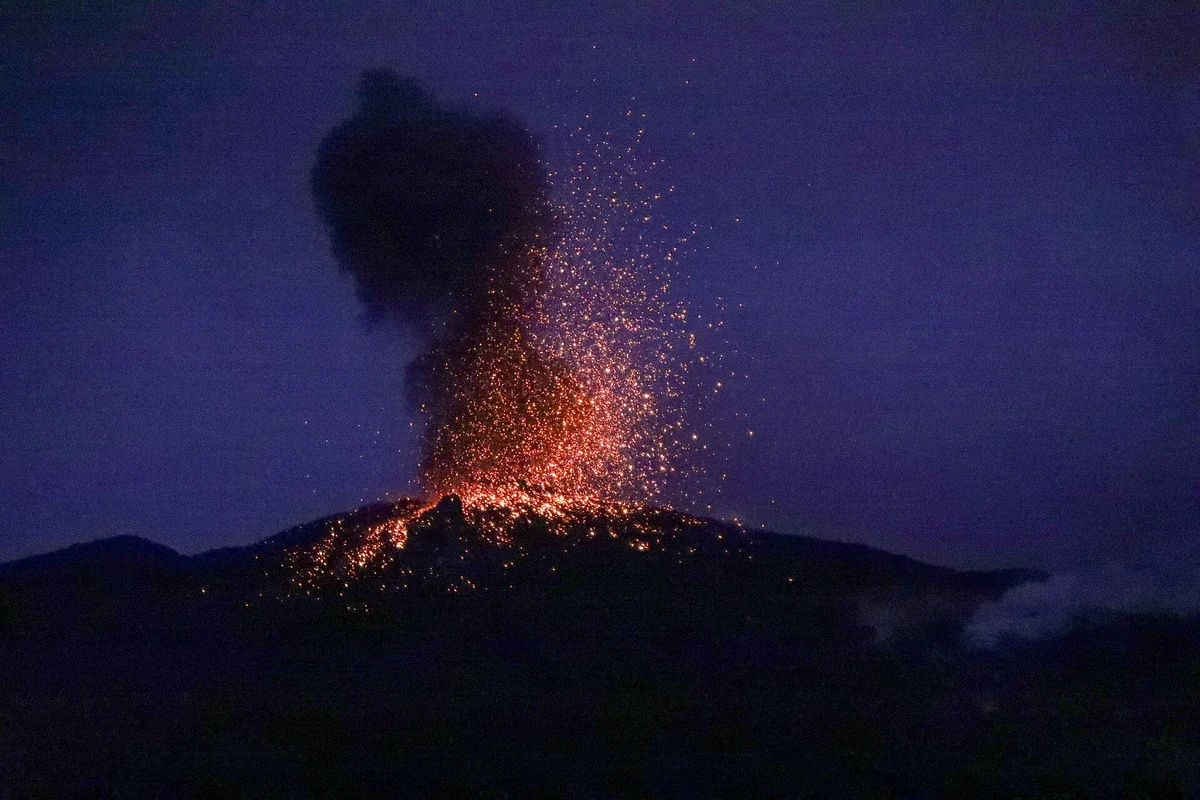
After the 2019 paroxysm: civil protection on the island. Photo: Dipartimento della Protezione Civile, CC BY 2.0, via Wikimedia Commons
The 2019 and 2024 Paroxysms, and What Changed After Them
Two larger explosions in five years shape the rules every visitor now walks under. Both are worth understanding before you book.
The two events
Rare larger explosions, called paroxysms, happened in 2019 and again in 2019, and a third strong paroxysm came in 2024. Each threw material high above the craters and briefly raised the civil-protection alert level. The 2019 paroxysm killed one hiker, a fact that reshaped access on the mountain permanently.
The 2024 event, strong enough to trigger a national civil-protection mobilisation decree, produced no fatalities, which says something about how the safety system held. These events are years apart, not a daily or even yearly rhythm, and nothing in the monitoring suggests they can be predicted to a date.
The access rules they left behind
The visible legacy is the altitude zonation. Free access runs to 290 m above sea level on the Stromboli village side, starting from Piazza San Vincenzo and passing the Belvedere viewpoint near the old cemetery at about 190 m. From 290 m to 400 m, only certified Alpine-Volcanological Guides may lead groups, under the Mayor of Lipari's standing ordinance, framework n. 100 of 2 September 2022, reissued since.
Above 400 m, up to the crater rim at 924 m, the mountain has been closed since the 2019 paroxysmal eruptions and remains closed. No operator sells a true summit hike today. Listings that use the word summit are selling the 400 m guided sunset trek.
On the Ginostra side the ordinance allows free access within lower limits, though Ginostra has no volcano-path tourism infrastructure worth planning a day around. The licensed-guide requirement is law on this volcano, and the guides carry helmets, set the pace, hold groups back from the exposed edge and read the volcano's behaviour in real time. That is the whole safety system, and it worked in 2024.
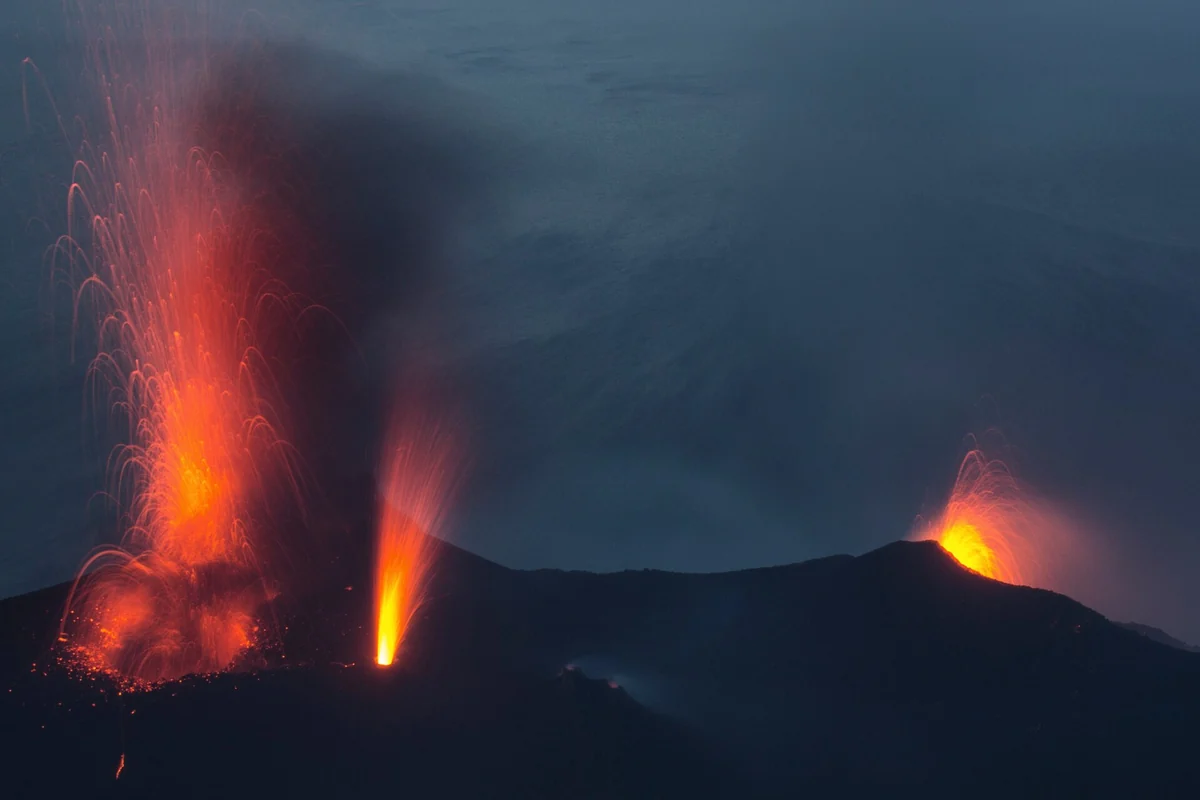
A night burst seen from the Sciara side: the treks' reward. Photo: Petr Novak, CC BY-SA 3.0, via Wikimedia Commons
How the History Changes a Booking
Ordinary activity and a closed summit change what you should look for in a listing. The filtering rules are short.
What to book in ordinary activity
In the current state, two formats cover the volcano. The first is the guided sunset trek to 400 m on the Sciara del Fuoco's eastern rim, which leaves about two hours before sundown and runs roughly April to October, when the light is long. The viewpoint sits about 350 to 400 m in a straight line from the craters, close enough that you feel the explosions in your chest.
The second is the night cruise, which holds position 300 to 500 m off the Sciara after dusk for about 30 minutes and runs year-round in season. Both are described in detail on the pages for the sunset trekking to the Sciara del Fuoco and the night cruise with eruption watch. The free alternative is the Belvedere near the old cemetery at about 190 m above the village, which sees the night glow.
Bring a torch for the walk back.
What to check before paying
Three checks do most of the work. First, does the listing state a turnaround point of 400 m or below, with a certified guide? Anything claiming the crater rim or the summit at 924 m is selling something that does not exist, because the upper mountain has been closed since 2019.
Second, are the fees transparent? The Aeolian Islands landing fee is EUR 5 per person, collected in cash at the port or ticket office on most sailings, and only one of the listings compared here in this catalog folds it into the price. From Milazzo there is also a seasonal port eco tax, about EUR 5 per person from 1 June to 30 September and about EUR 2.50 from 1 to 31 October.
There is no entrance ticket for the volcano itself, and no official source confirms the EUR 3 entry ticket one competitor listing mentions, so treat that line with suspicion. Third, check the cancellation terms against the season. Boats and treks run April to early November, the sailing timetable collapses in winter, and weather rather than volcanology cancels more evenings than anything else.
Compare all of it at compare current Stromboli tour prices.
Where You Can Watch, and What Each Option Gets You
Three practical viewpoints exist. They differ in cost, effort and how close the explosions feel.
The three viewpoints compared
The table below sets the options against each other. The decision column reflects what each gets you in ordinary activity, when the craters burst several times an hour. From the boat you watch the glow reflected in the water.
From 400 m you hear and feel the bursts. From the village Belvedere you see the glow for free. Eruptions are visible year-round when the volcano is in ordinary activity and the sky is clear, but boats sail in season only, April to early November.
| Viewpoint | Access rules | What it costs | Verdict in ordinary activity |
|---|---|---|---|
| Boat hold off the Sciara del Fuoco | Booked tour, no walking, most cruises hold about 30 minutes | Tour price plus EUR 5 landing fee in cash on most sailings | Best for the classic sight, crater glow mirrored in the sea, and the easiest option with children |
| Guided trek rim at 400 m | Certified AIGAE guide only from 290 m, under the Mayor of Lipari's ordinance, helmets carried | Tour price plus the same landing fee and trek kit you bring yourself | Best for sound and force, roughly 350 to 400 m line-of-sight from the craters, you feel each burst |
| Belvedere near the old cemetery, about 190 m | Free path from Piazza San Vincenzo on the village side, no guide needed to 290 m | Nothing but a torch for the walk back | Best free option for the night glow, honest but distant compared with the other two |
Timing the evening
Sunset treks leave about two hours before sundown, so the guided season tracks the long-light months from about April to October. The cruises' eruption watch happens after dark and runs through the whole sailing season. In June to September all departures operate, the sea is warm and sunset timing is reliable.
May, June and September are the sweet spot, with the season in full swing and the villages calmer. July and August are hottest and busiest. October is quiet, with the first storms possible.
Winter keeps the volcano erupting but day trips become unreliable as the inter-island hydrofoils thin out. On any given evening, weather is the usual spoiler rather than the volcano.
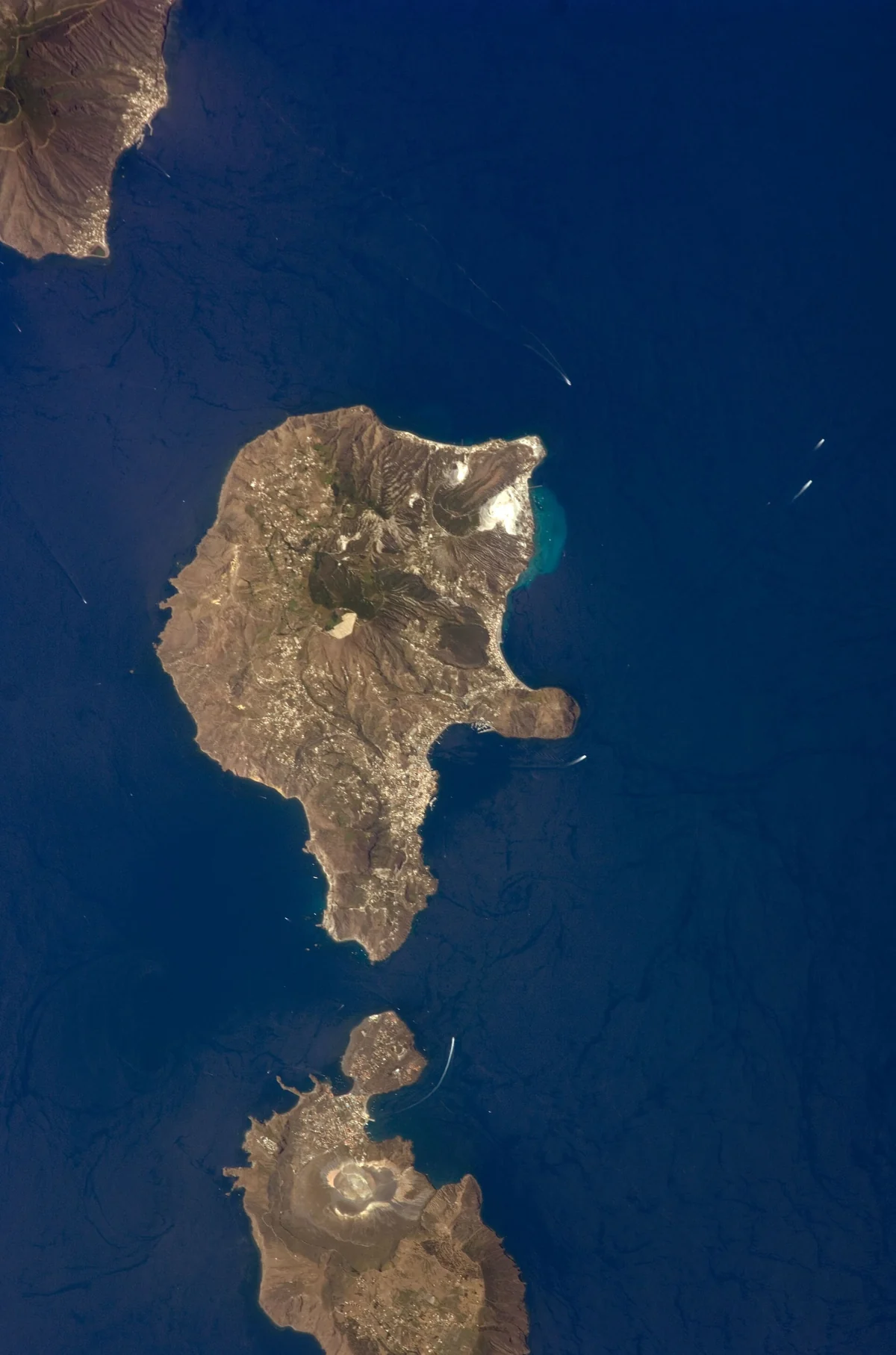
The archipelago from orbit: seven islands on a volcanic arc. Photo: NASA Expedition 17 crew, Public domain, via Wikimedia Commons
Which Plan Fits Your Trip
Ordinary activity suits almost every plan. Pick by how close you want to be and how much walking you want to do.
If You want the volcano as a spectacle with zero effort
The night cruise. It holds 300 to 500 m off the Sciara del Fuoco after dusk for about 30 minutes, needs no hiking gear, and runs year-round in season. Bring a windproof layer for the run home
If You want to hear and feel the explosions
The guided sunset trek to 400 m. Only a certified AIGAE guide can take you above 290 m, the viewpoint sits about 350 to 400 m from the craters, and it runs roughly April to October. Bring 1.5 to 2 L of water per person and closed hiking shoes
If You are on a budget or staying overnight on the island
The free Belvedere near the old cemetery at about 190 m. Walk up from Piazza San Vincenzo, watch the glow, and carry a torch back down
If An alert level rises while you are booked
Expect the guided treks to 400 m to suspend and boats to hold further off until the civil-protection level drops. After both paroxysms the system returned to baseline quickly. Read the bulletin at INGV, check Protezione Civile, and lean on your operator's cancellation terms
Stromboli's Activity: Questions Travellers Ask
Is Stromboli volcano still erupting?
Yes, in its ordinary state. INGV Osservatorio Etneo weekly bulletins recorded ordinary Strombolian activity from both crater areas through September 2026, with moderate-to-high degassing and explosions ongoing in the week of 7 to 13 September, and no elevated alert in force on the checked dates. This mild style, small gas explosions at the crater rims several times an hour, has held near-continuously for centuries and is the reason the activity type is named after the island. For a visitor this is good news rather than a warning. It means the glow and the bursts are there on any clear evening, and the tours built around the volcano, both the boats and the guided treks, operate normally. The authoritative sources to recheck before you travel are the INGV bulletins and the civil-protection updates.
Does Stromboli erupt every night?
Effectively yes, in the sense that matters to a traveller. In ordinary activity the craters burst several times an hour through the day and night, so after dark there is almost always a visible glow and repeated bursts above the Sciara del Fuoco. A clear evening almost always shows something, and the usual spoiler is weather, not the volcano. What no one can promise is the size of any individual burst. Small explosions are the nightly rhythm. Large paroxysms are rare, years apart, and not scheduled, so no tour can guarantee one. Boats hold position 300 to 500 m off the Sciara after dusk, most for about 30 minutes, and the guided viewpoint at 400 m gives you the sound and the shock of each burst. If a night cruise or trek is cancelled, it will be for sea or cloud far more often than for anything the monitoring reports.
Is Stromboli the most active volcano in the world?
It is one of the most active volcanoes on Earth, and the claim rests on consistency rather than size. Stromboli has been in near-continuous ordinary Strombolian activity for centuries, erupting several times an hour without long pauses, which very few volcanoes on the planet match. The volcano stands 924 m tall on a small island of roughly 580 residents, the northernmost of the seven Aeolian Islands, which are a UNESCO World Heritage site. Its activity is mild in the ordinary state, small gas explosions at the crater rims, not the catastrophic style that word active sometimes suggests. The rare exceptions are the paroxysms of July and 2019 and 2024. For a traveller, its reliability is the attraction. You are not hoping for an eruption, you are visiting a volcano that has been performing on schedule for as long as records exist.
When was the last time Stromboli erupted?
It never stopped. The last paroxysm, the larger explosion most headlines would call an eruption, came in 2024. It threw material high above the craters and briefly raised the civil-protection alert level, with no fatalities. Before that, the last paroxysms were in July and 2019, and the 2019 event killed one hiker. Between and since those dates the volcano has continued its ordinary Strombolian activity, the small hourly explosions that give the island its glow. Through September 2026 the weekly INGV bulletins recorded ordinary activity from both crater areas with no elevated alert in force on the checked dates. So the honest answer depends on the sense of the word. As a large event, 2024. As any eruption at all, tonight, most likely.
Is it safe to visit Stromboli?
Within the rules, yes, and the rules are the safety system. Stromboli is monitored 24/7 by INGV under a civil-protection alert protocol. Free paths run to 290 m on the village side, only certified Alpine-Volcanological Guides may lead groups from 290 m to 400 m, and everything above 400 m has been closed since the 2019 paroxysmal eruptions. The guides carry helmets, set the pace, hold groups back from the edge and read the volcano's behaviour in real time. The licensed-guide requirement is law under the Mayor of Lipari's ordinance, not a sales device. The 2024 paroxysm produced no fatalities, which suggests the zonation works. Bring 1.5 to 2 L of water per person, closed hiking shoes and a layer for the top after dark, and stay inside the limits.
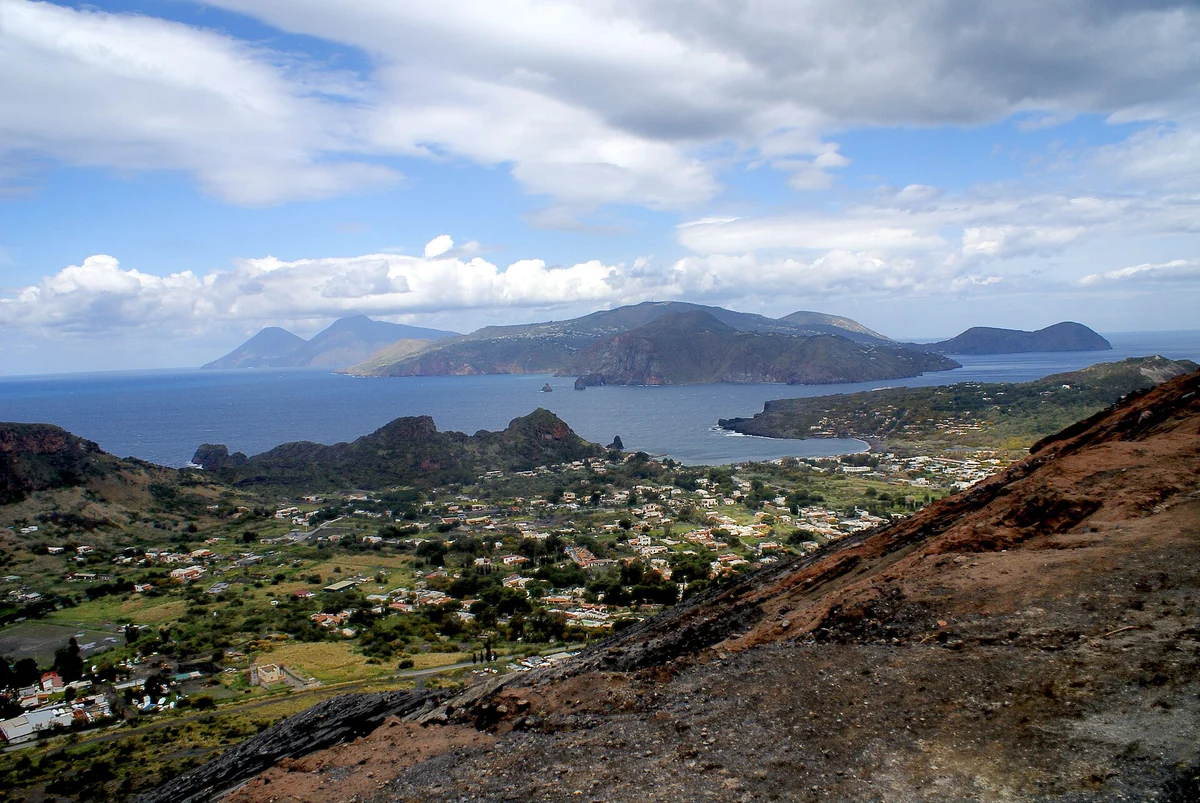
The volcanic arc from the water. Photo: Giovanni, CC BY-SA 2.0, via Wikimedia Commons