 Stromboli Volcano Tours
Stromboli: Sunset Trekking at Sciara del Fuoco
This page compares the Stromboli sunset trekking Sciara del Fuoco listing run by Ashàra, against all Stromboli volcano tours run by Ashàra Etna & Stromboli Guides. The climb ends at 400 metres on the eastern rim of the ash channel, the highest point any guided group is allowed on this volcano. From there you watch the crater eruptions after dark, then descend by torchlight. The listing carries 4.7 from 1,689 verified reviews, the largest review base of any trek on the island. This page unpacks the whole evening: the route stage by stage, what the $34.00 (€29) price covers, how the booking and cancellation mechanics work, what the craters actually look like in ordinary activity, and how the trek stacks up against the two honest alternatives, a smaller-format walk to the same line and the boat day from Milazzo.
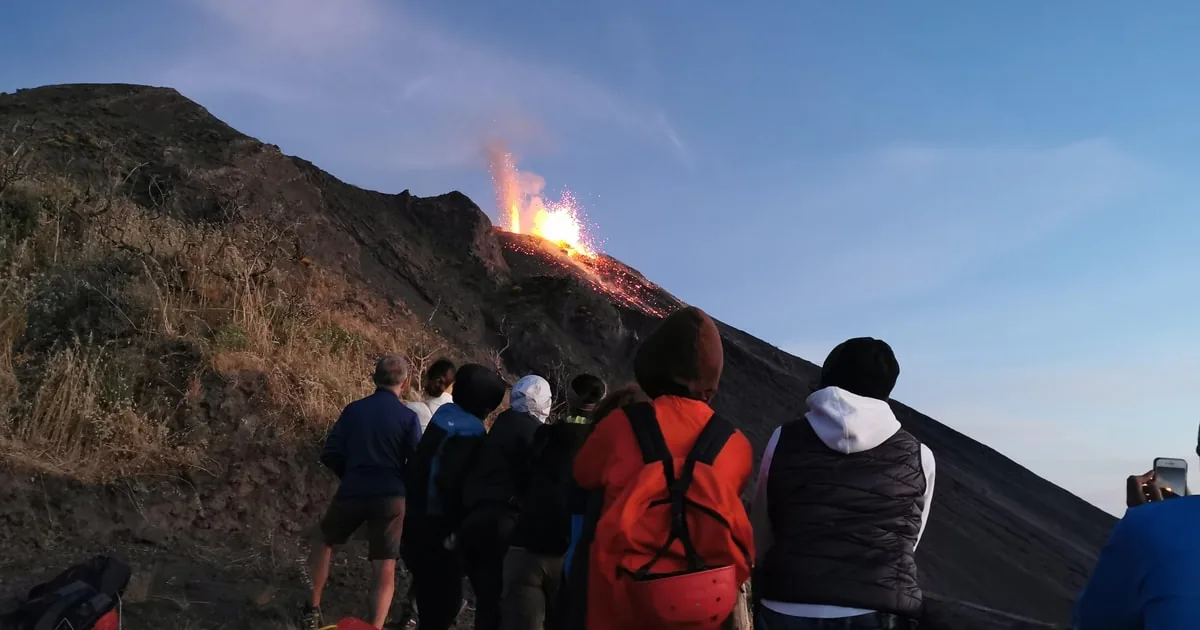
About This Listing
Ashàra Etna & Stromboli Guides runs the trek and sells it through GetYourGuide, where it is listed from $34.00 (€29) per person. It holds a rating of 4.7 across 1,689 reviews from verified bookings. The walk takes 5 hours door to door on foot from Stromboli village, with no transport involved. Groups are shared and capped at 25 people, with a private option sold separately, and guides work in English, French and Italian. The honest catch is the 400 metre cap: you never reach the crater rim at 924 metres, which has been closed since the 2019 eruptions, so every listing that says summit is selling this same viewpoint.
The 400 m limit is not the operator's choice. The Mayor of Lipari's standing ordinance allows free access up to 290 m and guided access with a certified Alpine-Volcanological Guide from 290 m to 400 m. Above that, the zone is closed. What you get instead is the eastern rim of the Sciara del Fuoco, the steep scree funnel that channels eruptions into the sea, with the craters roughly 350 to 400 m line-of-sight away. At that distance the explosions are sound and vibration as much as spectacle, which is exactly what the reviews keep coming back to. The guide's job on this volcano is written into law: setting the pace, holding the group back from the edge and reading the volcano's behaviour in real time through the evening.
Check Dates and Availability
Quick answer Price, the 400 m cap and the torch-lit descent in 30 seconds
From $34.00 (€29) per person for a 5-hour guided sunset trek to the 400 m viewpoint on the Sciara del Fuoco, the highest altitude open on Stromboli under the Mayor of Lipari's ordinance. Above 400 m the volcano is closed, so no tour goes to the crater rim. The catch: a shared group of up to 25 sets one pace, and recent reviews note the pace can feel slow for fit hikers.
Key takeaways
- Departure is about 2 hours before sunset and shifts with the season, so check live dates before you fix the rest of your day
- If a group of 25 sounds like a crowd, the Sunset Excursion on the Stromboli Volcano is the honest alternative, a smaller-format walk to the same 400 m line
- For the wider picture of fees, seasons and the closed zone, read the Stromboli volcano guide
What the Day Actually Looks Like
The trek is a single out-and-back on foot from Stromboli village, timed so the group stands on the Sciara rim as the light goes. Here is the shape of the 5 hours, from the listing and the operator's own terms.
The route, stage by stage
You meet at Piazza San Vincenzo two hours before sunset, and the exact start shifts with the season. The path climbs a nature trail through Mediterranean scrub, passing the island's old cemetery near the Belvedere at about 190 m, with views out to Strombolicchio. From 290 m upward you are inside the guided zone, where the law requires a certified Alpine-Volcanological Guide. The trail tops out on the eastern rim of the Sciara del Fuoco at 400 m, roughly 350 to 400 m line-of-sight from the craters, in time for sunset. The group stays for full dark while the craters burst, then puts on head torches for the descent, reaching the village about 2 hours after sunset.
The terrain is volcanic throughout and the climb is graded as intermediate. You gain 400 m of altitude on a sustained trail, not a scramble, but the ground is loose in places and the last stretch onto the rim needs the helmet the guide hands out at the briefing. Reviews describe a challenging trek in the heat with a wide range of ages managing it, so reasonable fitness matters more than technical skill. The timing logic is simple: leave two hours before sundown, stand on the rim as the light drops, stay for full dark, and walk down by torch. Because the start shifts with the season, check the live schedule before you book the rest of your evening around it.
| Stage | Time | What happens |
|---|---|---|
| Meeting | 2 hours before sunset | Ashàra Info Point behind Piazza San Vincenzo, safety briefing and helmet fitting |
| The climb | Roughly the first 2 hours | Nature trail through Mediterranean scrub, past the old cemetery at about 190 m, into the guided zone above 290 m |
| The 400 m viewpoint | Sunset | Eastern rim of the Sciara del Fuoco, about 350 to 400 m line-of-sight from the craters |
| Eruption watch | Sunset to full dark | Gas explosions several times an hour, heard and felt as much as seen, against the crater glow |
| The descent | About 2 hours after sunset | Torch-lit walk back down the same route, arriving in the village in the dark |
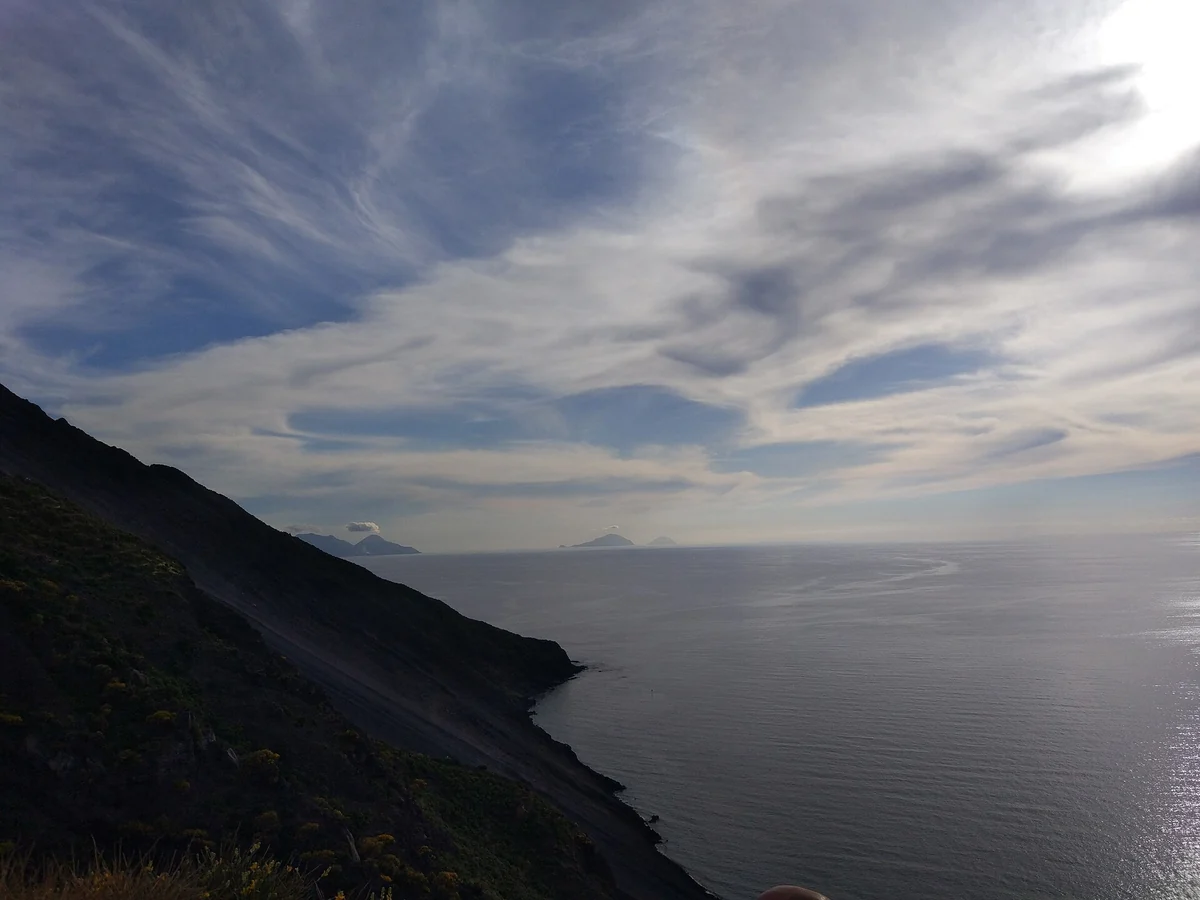
The Sciara del Fuoco from the trail side: the funnel every eruption drains down. Photo: Shayshal2, CC BY-SA 4.0, via Wikimedia Commons
Photography, Light and What You Will Actually See
Set expectations before you book, because the volcano decides the show and the light decides the photos.
Shooting the eruptions from the rim
Your vantage is the eastern rim of the Sciara del Fuoco at 400 m, looking across the channel toward the craters at roughly 350 to 400 m line-of-sight. That is close enough that the explosions arrive as sound and a pressure thump a beat after the flash, which no boat deck at 300 to 500 m distance can give you. The craters sit above you on the skyline, so bursts read against the sky rather than against rock.
After full dark the crater glow itself becomes the subject, a red stain low over the ridge that flares with each explosion. A torch is provided for the walk but bring spare batteries for whatever you shoot with, since there is nowhere to charge anything above the village.
The light and the ordinary show
The timing is built around the hour when the light is long and then gone. You arrive at the rim at sunset, so the climb happens in warm low light with views out to Strombolicchio, and the eruption watch runs from sunset into full dark. In ordinary activity, which is how Stromboli has behaved for centuries, the craters burst several times an hour: small gas explosions at the crater rims, the style that gave volcanology the word Strombolian.
A clear evening almost always shows something. It is a natural event and no tour can guarantee a large burst. The rare bigger paroxysms happened in July and 2019 and 2024, years apart, and they are not scheduled.
The honest paragraph on no-show odds
The realistic risk to this booking is weather, not the volcano. Eruptions run around the clock in ordinary activity, so the mountain is rarely the problem. Low cloud, fog on the upper slopes, rain and wind can all spoil the viewing or force a cancellation for safety, and the operator reads conditions in real time.
That is the point of a certified guide rather than a self-guided walk. Book early in your stay if you can, so a washed-out evening leaves room to rebook, and use the free cancellation up to 24 hours before the start if the forecast turns against you.
The Evening, Step by Step
-
2 hours before sunset
Meet at Piazza San Vincenzo
The group gathers at the Ashàra Info Point behind the square, the guide runs the safety briefing and hands out helmets and torches.
-
Start of the climb
Nature trail through the scrub
A sustained intermediate climb on volcanic terrain, passing the island's old cemetery and looking out towards Strombolicchio.
-
About 2 hours after the start
The 400 m viewpoint
The group reaches the eastern rim of the Sciara del Fuoco as the sun drops, the highest point open under the civil-protection ordinance.
-
Sunset to full dark
Eruption watch
The craters burst several times an hour in ordinary activity. At this distance you hear and feel the explosions as much as see them.
-
About 2 hours after sunset
Torch-lit descent and return
The group walks back down the same trail by torchlight, reaching Stromboli village in the dark about 5 hours after the start.
Where You Meet
The trek meets at the Ashàra Info Point behind Piazza San Vincenzo in Stromboli village and sets out on foot.
- 1 Ashàra Info Point, behind Piazza San Vincenzo, StromboliThe meeting point for the sunset trek. The walk starts on foot from here, 2 hours before sunset.
Numbers match the pins on the map.
What Is Included, and What Is On You
The listing is clear about the split between what the operator provides and what you carry yourself.
Included in the $34.00 (€29) price
The following come with the booking. The guide, helmet and torches cover everything the law and the dark demand. The landing fee folded in is worth a sentence of its own, because most operators collect it separately in cash at the port, and this listing is one of the few that spares you that queue.
- Certified Alpine-Volcanological Guide, required by law above 290 m
- Helmet
- Torches for the descent
- Aeolian Islands landing fee, folded into the price rather than collected in cash
- Safety briefing and real-time reading of the volcano's behaviour
- Free cancellation up to 24 hours before the start
What you bring
The operator's terms and recent reviews point to the same short list. Bring closed hiking shoes, 1.5 to 2 litres of water per person, and a warm layer to put on at the top, because the viewpoint sits in the wind after dark. Reviews single out boots, water and warm clothes as the three things not to skip. There is no food or drink on the trek, and no hotel pickup, the walk starts in the village.
A note on footwear, since it is the item people most often get wrong. The trail is volcanic and loose in the upper section, and the last part of the climb onto the rim is done in a helmet. Sandals, smooth-soled sneakers and city shoes will make the descent by torchlight worse than it needs to be. Pack the warm layer at the bottom of your bag so it is waiting when you stop moving at the rim, because the temperature drop between the climb and full dark is the part of the evening nobody photographs.
The fee honesty line
The Aeolian landing fee is included in this listing's price, which makes it one of the few that does not collect the EUR 5 in cash at the port. There is no entrance ticket for the volcano itself. If you arrive via Milazzo in season, the port eco tax of about EUR 5 per person from 1 June to 30 September is collected separately and is never part of a tour price.
That means the only money you need on the day itself is whatever you want for the village before or after the walk. There is no ticket office at the trailhead and nothing to pay above 290 m. The listing price converts from euros at EUR 1 = USD 1.17, so the figure you are billed depends on the platform and the day.
How It Compares
The two rivals worth naming are the small-group town walk by Sicilia Adventure and the boat day from Milazzo. The column that decides it is time at the volcano.
The same viewpoint, or none at all
Both rivals are honest products, they just solve a different problem. The Sicilia Adventure excursion walks to the same 400 m line in a smaller group and is the pick if you want a quieter hill. The Tarnav boat is for people based on the mainland who cannot overnight on Stromboli, and it buys two islands for its 30 minutes off the Sciara. If seeing the eruptions from land, in the dark, is the point of the day, the Ashàra trek is the benchmark for a reason.
Three numbers do most of the work in this comparison. The first is time at the volcano: the trek holds the rim from sunset to full dark, the smaller-format walk makes a long stop at the same viewpoint, and the Milazzo boat gets a 30-minute hold off the Sciara and no time on the mountain at all. The second is language: this trek runs guides in English, French and Italian, the rival walk covers English and Italian, and the boat is Italian only with no English guide stated. The third is money: at $34.00 (€29) from, this trek undercuts the boat by nearly $30 while giving you the whole evening on foot.
| Tour | From | Duration | Time at the volcano | Guide language | The decision |
|---|---|---|---|---|---|
| Ashàra sunset trek (this page) | $34.00 (€29) | 5 hours | Sunset to full dark at the 400 m viewpoint | English, French, Italian | Book this if you want the most-reviewed guided sunset trek and a guide in three languages |
| Sunset Excursion on the Stromboli Volcano | $34.84 (€29.78) | Not stated | A long stop at the 400 m viewpoint | English, Italian | Book this if you want the same walk with a smaller-format operator |
| Panarea and Stromboli Boat Trip by Night from Milazzo | $63.00 (€53.85) | 10 hours | A 30-minute boat hold off the Sciara del Fuoco | Italian only, no English guide stated | Book this only if you cannot stay on Stromboli and accept no time on the mountain |
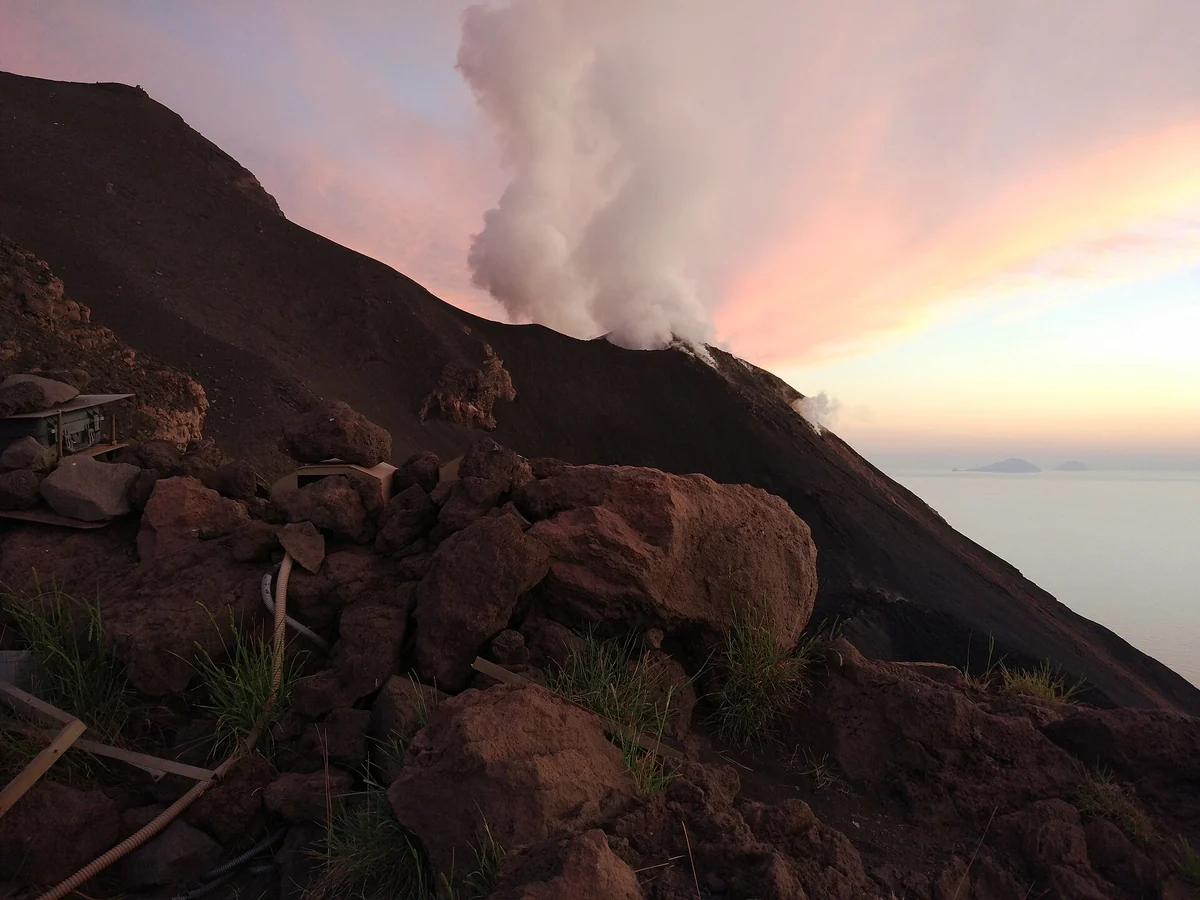
The crater terrace at sunset, seen on the guided ascent. Photo: Shayshal2, CC BY-SA 4.0, via Wikimedia Commons
Who This Suits, and Who Should Book the Alternative
A short sort of the room
The listing's size and group format decide most cases. Read the list against your own fitness and patience for other people's pace, because reviews on both sides of that question are the most useful signal in the whole 1,689-review base.
- Book this trek if you want the island's proven sunset walk, with the largest review base, guides in English, French or Italian and the landing fee already in the price
- Book it if you are comfortable in a shared group of up to 25 and want a 5-hour format with a fixed, reliable shape
- Book the Sunset Excursion on the Stromboli Volcano if you would rather walk the same 400 m route with Sicilia Adventure's smaller operation and a long stop facing the craters
- Take a boat trip instead if you are not up for an intermediate climb of 400 m on volcanic terrain, since neither this trek nor its rival is suitable for wheelchair users or anyone who cannot manage a sustained climb
- Skip both and watch free from the Belvedere at about 190 m above the village if you want the glow without the climb, bring a torch for the walk back
The pace question, answered honestly
A shared group of up to 25 means one pace for everyone, and the recent reviews are split on it. Several praise guides for managing mixed ages and nationalities well and still arriving at the viewpoint before sunset. Others flag the pace as slow for fit hikers and suggest the operator might run a separate group for novices.
Nobody in the reviews missed the eruptions over it, and the guides are credited repeatedly with making sure the whole group reached the viewpoint. If a slow shared pace would genuinely ruin your evening, that is the case for the smaller-format rival walk rather than a reason to skip the mountain.
Booking Mechanics and the Fine Print
How the reservation, the cancellation and the check-in actually work on this listing, read from the operator's terms.
Cancelling, and paying later
Free cancellation runs up to 24 hours before the start, so a change of plan or a bad forecast the day before costs nothing. The listing also supports reserve now and pay later, which means you can hold a place on a specific evening without paying upfront. That combination is useful on an island where the sailing timetable can shift your plans and the weather can change an evening.
There is a private option sold separately from the shared group if you want your own party and your own pace, priced by the operator rather than on the per-person listing.
Checking in on the day
There is no hotel pickup and no ticket to collect in advance. You present yourself at the Ashàra Info Point behind Piazza San Vincenzo two hours before sunset, your voucher or booking reference on your phone is enough, and the guide runs the safety briefing there. Helmets and torches are handed out at the briefing.
Everything after that is on foot from the square. Arrive with water already carried, because there is no shop stop built into the schedule and nothing for sale on the trail.
Bad weather and elevated volcanic activity
The guide reads the volcano's behaviour in real time, and the route's altitude limit exists precisely so there is room to make safe calls. If conditions force a change, the group stays inside the open zone or the trek is cancelled, and the free cancellation terms apply to you rather than against you. Storms and low cloud are the realistic cancellation causes, and the operator's own communication is the channel for any change, so keep your phone reachable on the day.
Rare larger paroxysms happened in July and 2019 and 2024, and the response to those has been closures of the upper zone, which is why the 400 m cap has held since 2019.
The landing fee on this listing
The Aeolian Islands disembarkation fee of EUR 5 per person is folded into this listing's price, so you do not join the cash queue at the port that most sailings run. There is no volcano entrance ticket on top, and no official source confirms any entry fee for the mountain itself. If your route to the island passes through Milazzo between 1 June and 30 September, the port eco tax of about EUR 5 per person is collected separately there and is never part of any tour price, so budget for it on the crossing rather than on this trek.
Stromboli Sunset Trekking: Questions People Ask
Is Stromboli island worth visiting?
The reviews on this trek argue yes. It is the northernmost of the seven Aeolian Islands, a UNESCO World Heritage site with about 580 residents, no cars in the village and one of the most active volcanoes on Earth. Visitors describe the eruption watch as the highlight of an Aeolian trip, and one reviewer on this page rated the experience highly enough to do the trek twice. The island is small enough to walk end to end in an afternoon, the village sits on a black beach below the volcano, and the trek gives the trip its centrepiece. If your Aeolian itinerary has room for one big evening, this is the one most people pick.
Does Stromboli erupt every night?
In ordinary activity the craters burst several times an hour, around the clock, so a clear evening almost always shows explosions and glow. It is a natural event and no tour can guarantee a large burst. The style is mild and constant, small gas explosions at the crater rims, which is why the term Strombolian exists in volcanology. Weather, not the volcano, is the usual spoiler, since cloud or rain can hide even a good show. The realistic way to protect your evening is to keep your first booked night flexible and use the free cancellation if the forecast turns.
How far is Stromboli from Sicily?
About 55 km north of the Sicilian coast at Milazzo. The hydrofoil crossing takes 1 to 2.5 hours, and a car ferry takes up to 6.5 hours. Milazzo is the practical mainland port, roughly 2.5 hours from Catania by road or train via Messina, and it runs 8 to 13 daily sailings to Stromboli in high season. There are also inter-island links from Lipari at roughly 1 to 1.5 hours and seasonal routes from Naples, Messina, Palermo and Reggio Calabria. Because the trek starts in the village, book a ferry that lands you in Stromboli with time to spare before the meeting.
Is Stromboli still erupting?
Yes, in its ordinary way. INGV Osservatorio Etneo weekly bulletins recorded ordinary Strombolian activity from both crater areas with moderate-to-high degassing, with no elevated alert in force on the checked dates. This is the near-continuous behaviour the volcano has shown for centuries, and it is what the trek is built to watch. Rare larger paroxysms happened in July and 2019 and 2024, throwing material high and briefly raising the civil-protection alert level. They are years apart, not a daily event, and the route above 400 m has been closed since 2019.
Why can the trek only go to 400 metres?
The Mayor of Lipari's standing ordinance allows free access up to 290 m and guided access with a certified Alpine-Volcanological Guide from 290 m to 400 m. Above 400 m, up to the crater rim at 924 m, the zone has been closed since the 2019 paroxysmal eruptions. The licensed-guide requirement is law on this volcano, not a sales device. Every operator sells the same 400 m viewpoint, so a listing that claims a summit hike is selling this trek under another name. The honest framing is that the cap costs you altitude and buys you the closest legal point to an actively erupting crater.
Is the trek hard, and what should I pack?
It is graded as an intermediate climb of 400 m on volcanic terrain, about 2 hours up and 2 hours down by torchlight, for 5 hours door to door. You need closed hiking shoes, 1.5 to 2 litres of water per person and a warm layer for the top, where the viewpoint sits in the wind after dark. Reviews single out boots, water and warm clothes as the three things not to skip, and describe it as challenging in the heat but manageable for mixed ages. There is no food or drink on the trek. If a sustained climb is not realistic for you, the boat option or the free Belvedere at 190 m is the better fit.
What Travellers Said
Really nice guide, who explained everything very well. The hike was beautiful and the vulcano eruptions were amazing. I 100% recommend doing this when you are on Stromboli!
An amazing spectacular experience, well worth doing, so I did it twice.
Amazing tour and super informative guide. I recommend following their guidelines, especially boots, water, and warm clothes to either change into or put on.
It was fantastic! Watching the eruptions was mesmerizing!
Prices, availability and terms are set by the operator and confirmed at checkout.
We may earn a commission if you book through one of our links, at no extra cost to you. Full affiliate disclosure