 Stromboli Volcano Tours
Stromboli by Night: the Eruption Boats, Port by Port
Stromboli by night is one of the strangest regular boat trips in the Mediterranean. A vessel leaves a mainland or island port in the late afternoon, crosses open water as the sun drops, then holds station a few hundred metres off the Sciara del Fuoco while the volcano throws glowing bursts into the dark. This page explains what that hold actually looks and sounds like, how the departure ports differ, and how to decide between a boat and the guided trek. If you want the wider picture first, start with which Stromboli volcano tour to book.
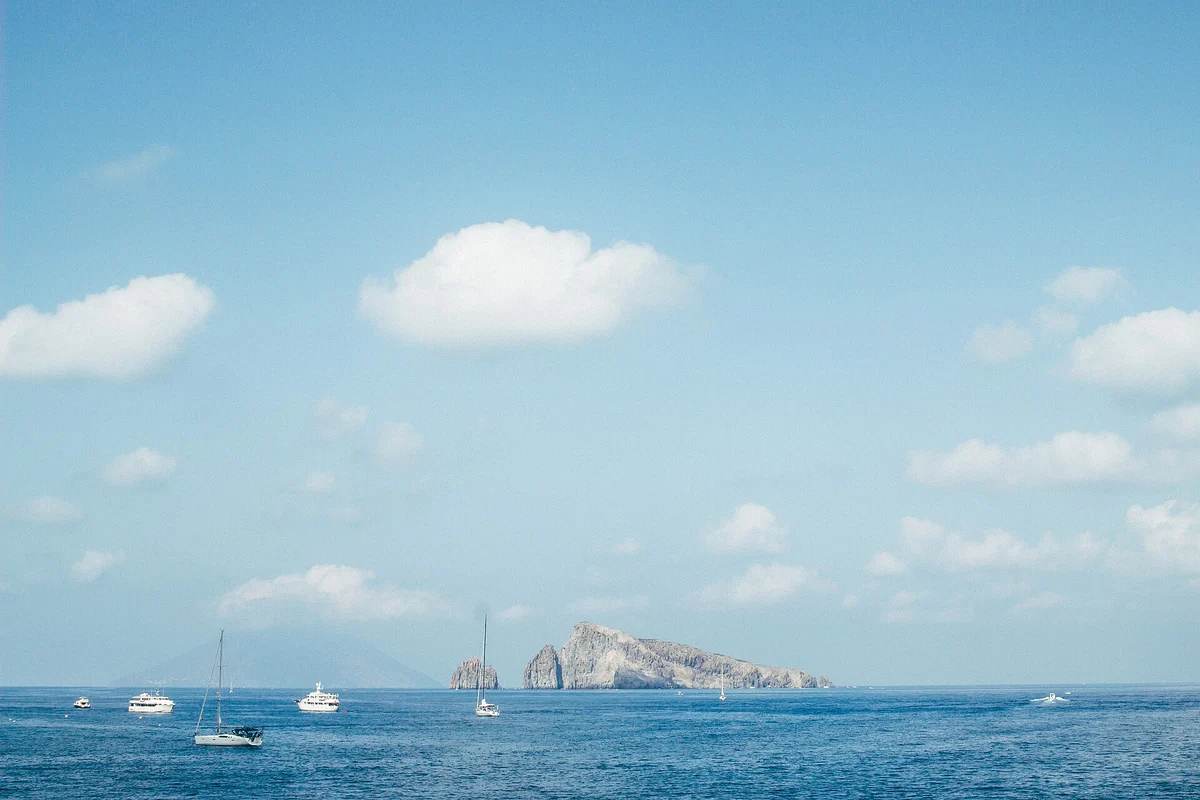
Stromboli seen from Panarea: the view every midday stop is built around. Photo: Giuseppe Murabito, CC0, via Wikimedia Commons
What the Thirty-Minute Hold Off the Sciara Is Actually Like
The Sciara del Fuoco, the channel of fire, is the steep scree funnel on the northwest flank of the island that channels eruptions down toward the sea. It is the one place where the crater activity is visible from below, and every night cruise on this island is built around it. Everything about the evening, from the departure hour to the shape of the ticket, is arranged to put a vessel in front of that slope after dark.
The approach
The boat rounds the northwestern corner of the island as the light fails. From the water the Sciara reads as a vast pale scar running from high on the cone straight into the sea, black rock at the waterline fading to grey above. The volcano stands 924 m tall, and from sea level the whole massif fills the windscreen.
Crews cut speed well before the hold position and the engine note drops, which is the moment the crowd on deck usually goes quiet. That quiet is worth noticing, because it happens on almost every sailing and it is the surest sign the spectacle is close. The boat then slides into position somewhere in the 300 to 500 m band off the slope, close enough that bursts are unmistakable, far enough that nobody on board feels exposed.
From that distance the crater rims read as a low orange line above the black outline of the cone, and the sea between you and the shore is often calm enough to act as a mirror.
The hold itself
Most night cruises hold for about 30 minutes, and the listing descriptions and recent reviews agree that it is the shortest and the best part of the evening. In ordinary Strombolian activity the craters burst several times an hour, so within half an hour you typically see a handful of explosions. Each one starts as a deep thud you feel through the hull before you hear it properly, then a bloom of orange light lifts above the crater rim, throws sparks that trace down the dark slope, and fades.
Between bursts the crater rims glow steadily. On a clear night the glow reflects on the water so the whole scene is doubled. The sound is the part that surprises people who only expect a light show.
It is not a roar but a heavy, delayed boom, arriving a beat after the flash because of the distance, followed by the wash of falling material. Recent weekly bulletins have recorded ordinary activity from both crater areas, which is exactly the behaviour the hold is designed for.
What it is not
This is not a fireworks display on demand. Ordinary activity varies in frequency and size from night to night, and no operator can guarantee a large burst. Rare bigger explosions, the paroxysms, happened in July and 2019 and again in 2024.
They are years apart, not a nightly feature. What the hold reliably delivers is the steady rhythm of a volcano that has been doing this for centuries, watched from a black sea with 580 islanders asleep behind you. That is the honest promise, and the good operators word it exactly that way in their listings.
Set your expectations at several modest bursts and you will come ashore happy, and expect weather, not the volcano, to be the thing most likely to spoil the show. Pick your port to shorten the crossing and treat the hold as the payoff.
Port by Port: Milazzo, Tropea and Lipari
The eruption watch is roughly the same on every boat. What changes is everything around it, because the ports sit at very different distances from the island and are served by very different kinds of vessel. The volcano does not care which coast you sail from, but your evening will feel completely different depending on whether the crossing is an hour or half a night.
Milazzo, the workhorse port
Milazzo on the Sicilian coast is the practical mainland gateway. It sits about 55 km from Stromboli and runs year-round ferry connections, with 8 to a dozen sailings daily in high season. It is also roughly 2.5 hours from Catania airport by road or train via Messina, which makes it the natural arrival point for anyone flying in.
Two kinds of night trip sail from here. The first is a dedicated evening run, the night boat trip from Milazzo, built around the eruption hold. The second is the fuller day format, the cruise excursion from Milazzo, which uses the daylight for the crossing and the island and keeps the Sciara hold for after dark.
Milazzo charges a seasonal port eco tax of about $5.80 (€5) per person from the start of June to the end of September and $2.90 (€2.50) for October, collected separately. Specific timetables for the night sailings are not stated on the listings read for this guide, so confirm the return hour before you book.
Tropea, the long-haul cruise
There is no regular passenger ferry from Tropea. The Calabrian port works through day-cruise operators, which is why the Tropea night cruise is a full evening excursion rather than a crossing. The nearest alternative is a seasonal hydrofoil from Vibo Valentia, about 1.5 hours and up to twice weekly, but for most Calabrian holidaymakers the cruise is the realistic option.
That shape has real advantages. You are fed and seated for the run, the approach to the Sciara comes straight off a Calabrian sunset, and you are back at your hotel without changing boats. The trade is time.
The distance from the Calabrian coast is greater than from Milazzo, so the fraction of the evening spent actually watching the volcano is smaller. Reviewers of these trips consistently flag exactly that, a long night with a short eruption window at the centre of it. If your hotel is in Tropea, that may still be the right deal.
Lipari and the inter-island runs
From inside the archipelago the sums change completely. Lipari sits about 1 to 1.5 hours from Stromboli, and Panarea is another 20 to 40 minutes on. The Panarea and Stromboli boat tour from Lipari uses that geography, giving you a stop at Panarea and an evening pass at the Sciara without a long open-water crossing.
Messina, Palermo and Reggio Calabria also run seasonal sailings toward the islands, and Naples sits 4.5 to 10.5 hours away, so the inter-island option is the short leg by comparison. If you are staying on the islands this is the least tiring way to see the eruptions, and it leaves the mainland days for something else. The table below puts the three ports side by side.
| Departure port | Crossing to Stromboli | Evening shape | Verdict |
|---|---|---|---|
| Milazzo | 55 km from the Sicilian coast, year-round ferries, hydrofoil 1 to 2.5 h | Dedicated night run or full-day cruise ending with the Sciara hold | Best for mainland base and choice of two formats |
| Tropea | No regular ferry, cruise operators only | Full evening cruise, sunset on the way out, hold after dark | Best if Tropea is your holiday base and you accept a long night |
| Lipari | About 1 to 1.5 h inter-island | Panarea stop plus evening eruption watch | Best for island stayers, least time at sea per minute of volcano |
The fee that follows you to every port
Wherever you board, the Aeolian landing fee applies. It is $5.80 (€5) per person, collected in cash at the port or ticket office before boarding on most sailings. Of the listings compared on this site only one folds it into the ticket price, so carry cash.
No official source confirms any volcano entry fee beyond this. None of the listings states its departure-time window in the material read for this comparison, so treat the return hour as a question for the operator. The same rule holds at every port in the table above, from Milazzo to Lipari.
Ask two questions when you book: what time you get back, and whether the landing fee is already inside the ticket. The answers decide more about your night than the boat's name does.
Sea State, Season and What Actually Ruins a Night
The volcano is rarely the problem. Boats sail in season from April to early November, and the craters burst in ordinary activity year-round, so the variable that decides your evening is almost always the weather and the sea. Read this section before you book rather than after, because most of what it describes can be planned around with a little forward thinking.
The season window
June to September brings warm sea, reliable sunset timing and every departure operating. July and August are the hottest and busiest months. May, June and September are the sweet spot, with the sailing season in full swing, water warm enough to swim on the stops that include one, and the villages calmer.
October is quiet but the first storms arrive. Winter is a different proposition entirely. The volcano keeps erupting, but the full sailing timetable collapses and day trips become unreliable.
Book winter dates only if you have flexibility. If you are locked to a week in a given month, book your eruption night for the first possible evening of the stay, because that leaves room to rebook when the sky turns against you.
How the sea behaves on the hold
The northern Tyrrhenian in summer is usually gentle by evening, and the wind typically eases after sundown, which is one reason the eruption watch works so well from the water. That said the hold position is off an open northwest coast with no shelter, so an onshore swell rolls straight in. Smaller vessels move more at anchor than big cruise hulls, and recent reviews of the smaller-group night trips mention this openly.
If you are prone to seasickness, take your remedy before boarding rather than during the crossing, because the run home after dark is the hardest stretch to medicate. Bring a windproof layer. The crossing home after the hold, with spray and night air, is cold even in August.
Nobody in the reviews regrets the extra jumper, and plenty regret leaving it in the hotel.
The real spoiler list
Ranked by how often it spoils the eruption watch, weather leads by a distance. Haze or low cloud hides the crater rim. A swell can force boats to hold further out or shorten the stop.
What does not appear on the list is the volcano, because ordinary activity is the default state here and has been for centuries. Even on an average night the odds are good. The craters burst several times an hour, so a clear evening almost always shows something.
A spectacular evening needs luck. For the current behaviour before you book, the eruption update page tracks the official weekly bulletins.
| Factor | Effect on the night | How to plan around it |
|---|---|---|
| Cloud or haze | Hides the crater glow and bursts entirely | Book early in your stay so you can rebook after a washout |
| Swell on the northwest coast | Longer hold distance, shorter stop, more boat movement | Pick a larger vessel or take seasickness remedy before boarding |
| Season collapse in winter | Timetables thin out and sailings become unreliable | Sail April to early November |
| Quiet volcano night | Fewer or smaller bursts than hoped | Accept the odds, ordinary activity means several bursts an hour |
Photography from a Moving Deck
Eruption photography from the water is a genuine technical challenge, and it is worth knowing what your camera is up against before you spend the hold fiddling with settings instead of watching. The deck moves, the subject is dark and brief, and the hold only lasts about 30 minutes, so preparation beats improvisation every time.
The light problem
You are shooting a distant, briefly bright subject across 300 to 500 m of dark water from a deck that is never fully still. Shutter speed is the whole game. Bursts last a second or two, so a shutter slow enough for a proper night exposure will smear the explosion and blur the boat.
The workable approach is to raise the ISO hard, open the aperture wide, and take many frames during each burst rather than one careful one. Phone cameras struggle most here. They can hold the crater glow as a composition, the steady orange rims over black water reflected on the sea, and that reflection shot is genuinely good on a phone.
What phones cannot freeze is the burst itself. Decide before you board which shot you are chasing, the glow or the burst, because trying for both usually delivers neither.
The sound-first advice
Several recent reviews of the night trips make the same point. The people who spent the hold behind a screen remember it less well than the people who watched. The bursts are quick, the sound arrives a beat late and rolls across the water, and the whole arc repeats several times in 30 minutes.
A reasonable compromise is to film one continuous vertical video of a full burst, which captures the flash, the falling sparks and the sound together, then put the device away for the rest of the hold. Steady the camera on the rail or a bulkhead rather than handholding, because the engine is idling and the deck trembles. That single clip will carry more of the experience than a gallery of blurred stills, and it frees the rest of the hold for actually being there.
What to bring
The operator packing advice for boat trips is straightforward. Swimwear and a towel if your sailing includes a swim stop, and a windproof layer for the evening run home. Add for photography a spare battery, because cold night air and long exposures drain them, and a cloth, because spray on the lens ruins more eruption shots than focus ever does.
Red-light mode on a head torch, if you have one, keeps you on good terms with everyone else on deck. If photography is the main point of the trip for you, note that the boats hold at a fixed distance with no say in framing. The guided trek from the rim trades comfort for control, which is the subject of the port-by-port comparison below.
Pack the night before, because the day boats leave early and shops on the island are thin on the ground.
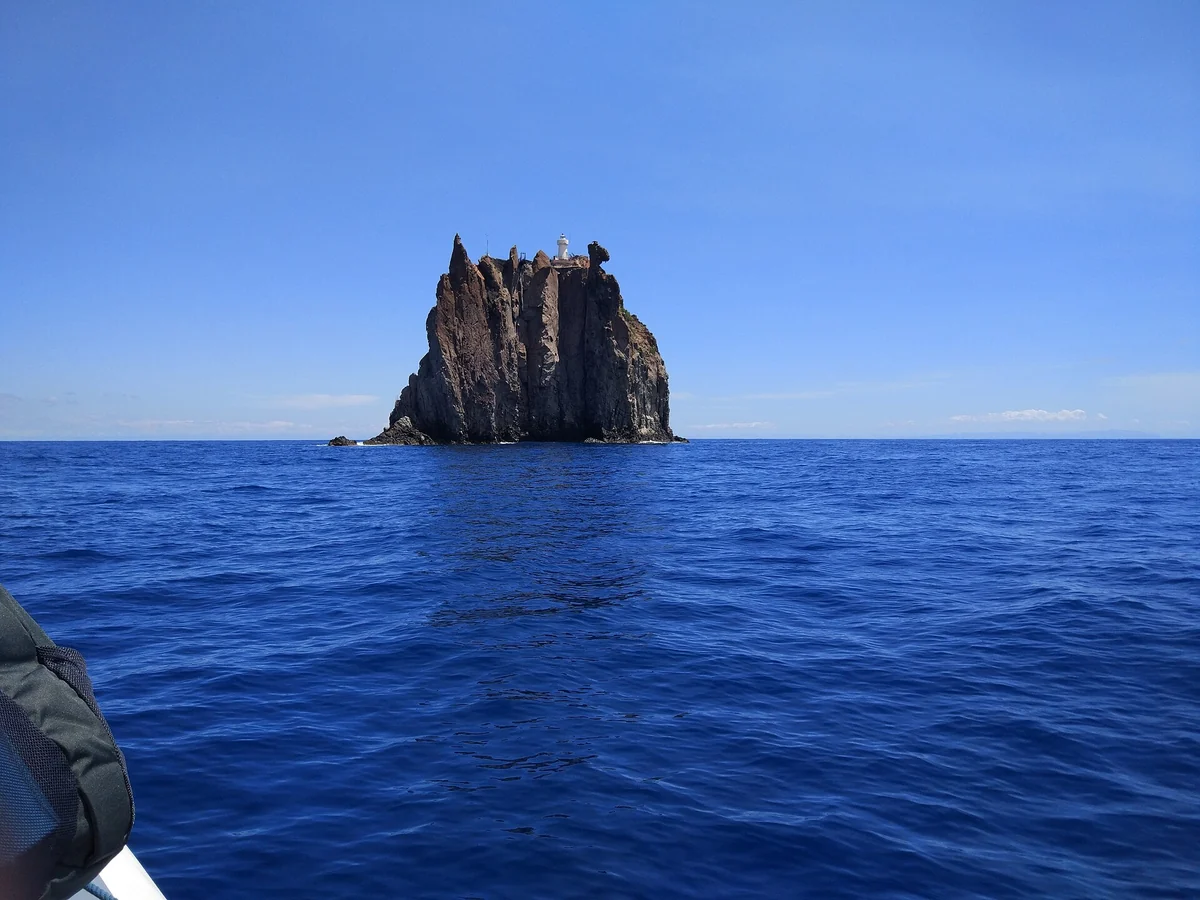
Strombolicchio and its lighthouse, the last light boats pass on the night run. Photo: Shayshal2, CC BY-SA 4.0, via Wikimedia Commons
Boat or Trek: Choosing Your Vantage Point
There are three ways to watch this volcano after dark. From the sea, from the guided viewpoint at 400 m, and free from the village. They are not interchangeable, and the right one depends on your legs, your schedule and what you want the eruption to feel like. Each has a hard limit written into the access rules, so read those before you choose.
From the sea, the 300 to 500 m band
The boat is the low-effort option and the most photogenic silhouette. You see the whole cone above you, the bursts framed against the sky, and the reflection doubling on the water. You arrive rested, fed on most sailings, and you leave for your own bed the same night.
There is no fitness requirement, no guide is mandatory, and the altitude rules that shape life on the island do not apply to a vessel offshore. What you give up is sound and scale. At 300 to 500 m the explosions are a show across the water.
The 30-minute hold is short, and the rest of the evening is crossing. For most visitors that trade works, which is why the boats sell night after night in season.
From the 400 m rim, the guided trek
The guided viewpoint path ends on the eastern rim of the Sciara at 400 m, roughly 350 to 400 m line-of-sight from the craters. At that distance you hear and feel the explosions as much as see them, which is the single biggest difference from the boat. Sunset treks leave about two hours before sundown and run roughly April to October.
Access rules matter here. Paths up to 290 m are free, the band from 290 m to 400 m is open only with a certified Alpine-Volcanological guide under the Mayor of Lipari's standing ordinance, and everything above 400 m has been closed since the 2019 paroxysmal eruptions. No operator sells a true summit hike.
Listings that say summit sell the 400 m trek. The licensed-guide requirement is law on this volcano, not a sales device, and guides carry helmets and read the volcano's behaviour in real time. You need 1.5 to 2 L of water per person, closed hiking shoes and a layer for the top after dark.
From the village, the free option
The Belvedere near the old cemetery, at about 190 m above the village, sees the night glow for the price of a walk. Bring a torch for the path back. It will not show the bursts the way the boat or the rim does, but on an active night the glow alone is worth the climb, and it costs nothing.
It is also the only option that needs no booking, no boat and no schedule, so it works on a whim after dinner. The table below lines the three vantage points up against each other.
| Option | Distance from craters | Cost beyond the island | Verdict |
|---|---|---|---|
| Night boat, Sciara hold | 300 to 500 m offshore | Tour price plus $5.80 (€5) landing fee | Best all-round view and the easiest night |
| Guided trek to 400 m | About 350 to 400 m line-of-sight | Guide fee, guide is mandatory by ordinance | Best for sound and physical experience, needs fitness |
| Belvedere from the village | Village side, glow visible | Free | Best budget and no-booking option |
How the Night Listings Compare
This site is a catalog, so the honest comparison here is structural rather than a table of numbers, because the individual departure prices are not stated in the material read for this guide. What the listings do fix is the shape of each evening, and shape is what you should book against. Two listings that end at the same hold can still be very different evenings.
Compare on fraction of night at the volcano
The number that separates a good eruption cruise from a forgettable one is the share of the evening spent within sight of the Sciara. A dedicated night run from Milazzo, the night boat trip from Milazzo, exists to do one thing and gets you to the hold and home. The full-day cruise excursion from Milazzo buys you a day on the water and the island with the eruption as the finale.
The Tropea night cruise is the longest evening for the same 30-minute hold. The Panarea and Stromboli tour from Lipari spends the least time crossing per minute of volcano. Decide first how much of your holiday day you are willing to trade, then pick the shape that matches.
If the volcano is the whole point of the trip, minimise the crossing, and if the day is a bonus, the cruise format earns its length.
Compare on fees and cancellation
Every sailing carries the landing fee of $5.80 (€5) per person in cash unless the listing folds it in. From Milazzo add the seasonal port eco tax, about $5.80 (€5) per person from the start of June to the end of September and $2.90 (€2.50) in October. No official source confirms any volcano entry fee, and a listing that invents one is a signal to read its terms carefully.
Booking, payment and cancellation sit with the booking platforms, not with this site, so check the cancellation window on the listing before you commit, and book your first night early in your stay so a weather washout leaves room to rebook. For the wider lineup beyond the night sailings, see Stromboli tours compared on price and duration. Figures current for Q3 2026.
| Listing | Port and evening shape | Known extras | Book it if |
|---|---|---|---|
| Night boat trip from Milazzo | Milazzo, dedicated evening run | Landing fee in cash, eco tax in season | You want the shortest path from mainland to Sciara |
| Cruise excursion from Milazzo | Milazzo, full day ending after dark | Landing fee in cash, eco tax in season | You want the island and the eruption in one day |
| Stromboli by night from Tropea | Tropea, full evening cruise | Landing fee in cash | You are based in Calabria and accept a long night |
| Panarea and Stromboli from Lipari | Lipari, inter-island with Panarea stop | Landing fee in cash | You are staying in the islands and want minimum crossing |
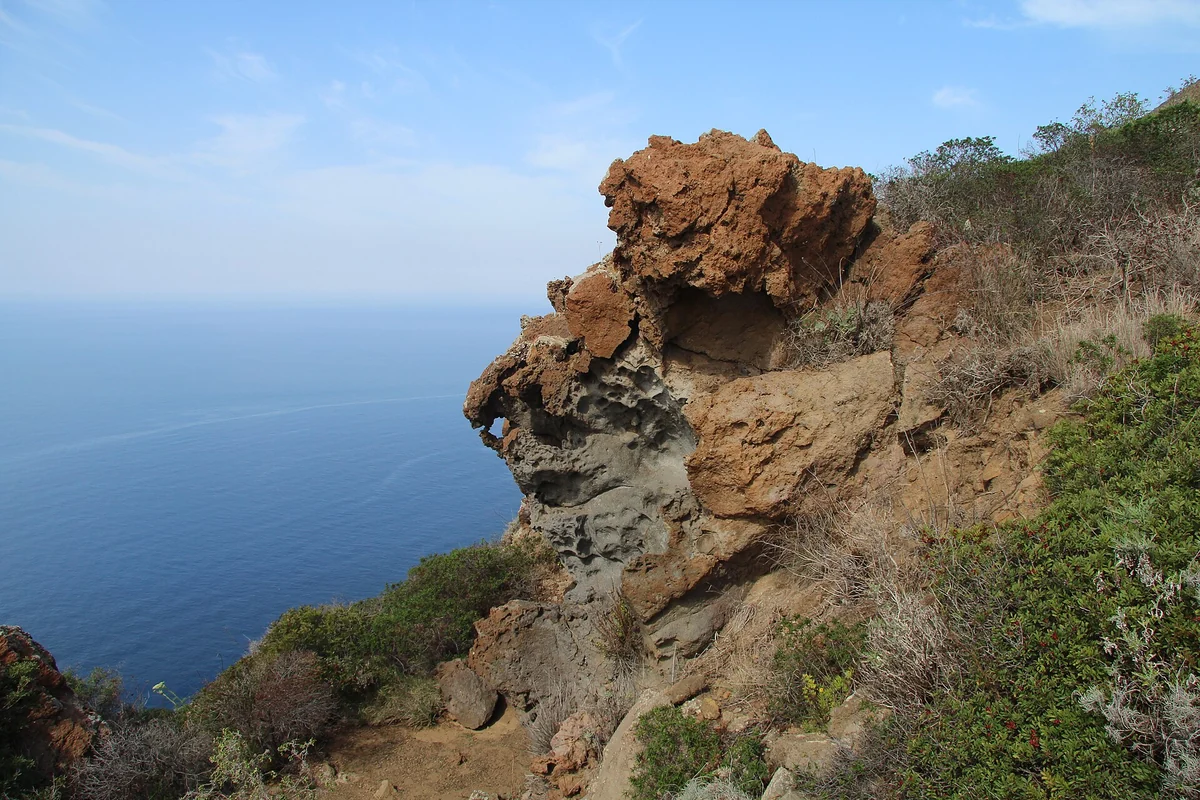
Panarea's white lanes, the shopping stop between the crossings. Photo: GerritR, CC BY-SA 4.0, via Wikimedia Commons
Quick answer Stromboli by night means a boat holding 300 to 500 m off the Sciara del Fuoco after dusk for a hold of about 3...
Stromboli by night means a boat holding 300 to 500 m off the Sciara del Fuoco after dusk for a hold of about 30 minutes, watching the crater glow and the regular Strombolian bursts reflected in the water. The volcano is in near-continuous ordinary activity, with small explosions several times an hour, so a clear evening almost always shows something. Weather spoils more nights than the volcano does. Departure ports are Milazzo and other Sicilian ports, Tropea in Calabria, and the inter-island ports such as Lipari, and the port you choose decides how long you spend crossing compared to watching.
Key takeaways
- The eruption watch itself is short, about 30 minutes at the Sciara, so the port you sail from shapes the whole evening
- There is no volcano entry ticket. Budget the landing fee of $5.80 (€5) per person and, from Milazzo in season, the port eco tax of $5.80 (€5)
- For current activity before you commit to a date, read the eruption update
- The boats and the 400 m guided trek show you the same explosions differently. The choice is covered in the boat versus trek section below
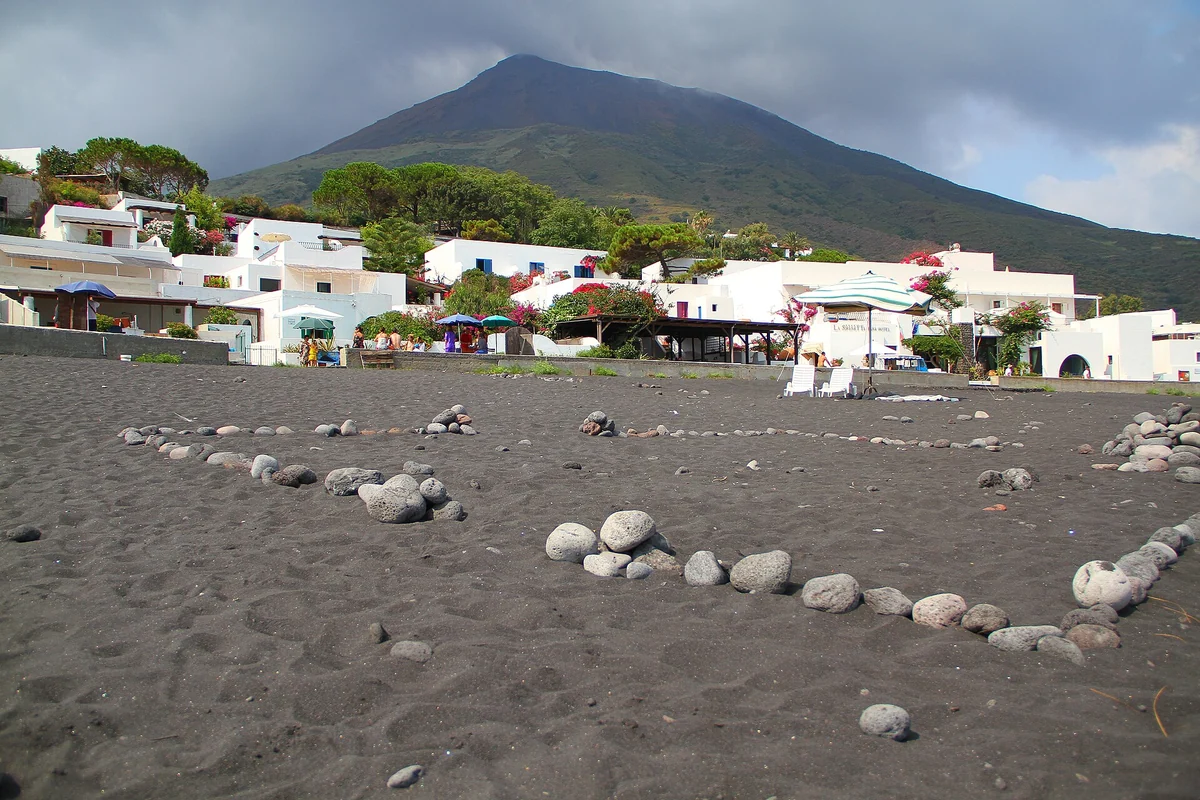
Black sand: the island's beaches are volcanic, not golden. Photo: Drtrotsky, CC BY-SA 3.0, via Wikimedia Commons
Which Night Out Fits You
If You are based on the Sicilian mainland and want maximum volcano per hour
The dedicated night boat from Milazzo, straight out and straight back around the hold
If You want the island itself as well as the eruptions
The full-day cruise excursion from Milazzo, with the Sciara hold as the finale
If Your holiday is in Tropea and you do not want to change bases
The Tropea evening cruise, accepting the long crossing for a door-to-door night
If You are staying in the Aeolian Islands
The Panarea and Stromboli tour from Lipari, the least time at sea per minute of volcano
If You want to feel the explosions, not just see them
Skip the boat and book the guided trek to the 400 m rim, where the sound arrives at full volume
The Case For and Against the Night Boats
What we genuinely like
- The full cone above you at night with the glow doubled in the water is the classic view for a reason
- No fitness requirement, no altitude rules and no guide mandatory, unlike the 290 to 400 m band on foot
- In ordinary activity the craters burst several times an hour, so the 30-minute hold almost always shows something
- Runs from three different coasts, so most itineraries in the region can reach it
The honest downsides
- The eruption watch is only about 30 minutes of a long evening
- Weather and sea state spoil more nights than the volcano ever does
- Prices are not stated in the material read for this guide and the landing fee is extra cash on most sailings
- The hold distance is fixed by the operator, so photographers get no control over framing
Who it's NOT for: Anyone who cannot tolerate a late return, travellers who get badly seasick even in modest swell, and hikers who want to feel the blasts, who should book the guided trek instead
The village seafront, cone overhead: the postcard the island sells. Photo: Sergio Ruiz S, CC BY 3.0, via Wikimedia Commons
Stromboli by Night: Questions Travellers Ask
Does Stromboli erupt every night?
Effectively yes, in the sense that matters for a night cruise. Stromboli has been in near-continuous ordinary Strombolian activity for centuries, meaning small gas explosions at the crater rims several times an hour, visible after dark as glow and bursts. That is the default state, not a special event, and it is why the volcanological term for this mild explosive style is named after the island. What is not nightly is a big one. The rare larger explosions, called paroxysms, happened in July and 2019 and 2024, years apart. No tour can guarantee a large burst. Weather, not the volcano, is the usual reason a night shows nothing.
Is Stromboli worth watching?
Recent reviews of the night sailings and the plain facts of the volcano both say yes, with one honest caveat. This is one of the most active volcanoes on Earth, small bursts several times an hour, watched from a boat holding a few hundred metres off the slope with the glow reflected in the sea. The sound arrives a beat after the flash and you feel it through the hull. The caveat is expectation. You are very likely to see several modest bursts in a 30-minute hold, not a Hollywood eruption, and the 30 minutes sit inside a much longer evening of crossing. Book the port that minimises your crossing and the odds are strongly in your favour.
Which is the prettiest Aeolian island?
Not stated as a fact anywhere official, so this is a matter of taste, but the comparison the region actually offers is between characters. Stromboli is the volcano island, about 580 residents, no cars beyond service vehicles, and a cone that glows over the village at night. Panarea is the small, fashionable one, 20 to 40 minutes further from Stromboli and a standard stop on the inter-island tours. Lipari is the largest and the practical inter-island hub, about 1 to 1.5 hours from Stromboli. Salina and Vulcano have their own followings. The whole archipelago is a UNESCO World Heritage site. If your measure is drama after dark, Stromboli wins the night.
Is it worth staying on Stromboli?
It changes the shape of your volcano watching completely. The village side has a free viewpoint, the Belvedere near the old cemetery at about 190 m, which sees the night glow, and paths up to 290 m are free without a guide. Staying over means you can watch the glow after the day boats leave and walk home with a torch instead of a two-hour crossing. The trade-offs are real. Everything is on foot or by small passenger boat, the full sailing timetable collapses in winter, and the island has roughly 580 residents so services are limited. If your priority is the eruption rather than the island, one night is enough to taste it. If you love quiet islands, longer.
Can you see the eruptions without paying for a tour?
Partly, yes. The free option is the Belvedere near the old cemetery above Stromboli village, at about 190 m, which sees the night glow of the craters, and paths up to 290 m above sea level on the village side are free with no guide needed. Bring a torch for the walk back down. What the free viewpoints do not give is the full burst view at close range. The band from 290 m to 400 m requires a certified guide by ordinance, everything above 400 m has been closed since 2019, and the closest sea view is from a boat. So the glow is free, the full show costs a ticket.
What extra fees do the night cruises charge?
Two, and they are small but easy to miss. The Aeolian Islands landing fee is $5.80 (€5) per person, collected in cash at the port or ticket office before boarding on most sailings, and only one of the listings compared on this site folds it into the price. From Milazzo there is also a seasonal port eco tax, about $5.80 (€5) per person from the start of June to the end of September and $2.90 (€2.50) in October, collected separately when it applies. There is no entrance ticket for the volcano itself, and no official source confirms any volcano entry fee beyond these. Bring cash for the landing fee.
Is it safe to watch the eruptions from a boat?
The boats hold 300 to 500 m off the Sciara del Fuoco, outside the slope that channels eruptions into the sea, and this format has run for decades in ordinary activity. Stromboli is monitored around the clock by INGV with a civil-protection alert protocol, and the alert level was not elevated during the ordinary activity recorded through the most recent weekly bulletins. The genuine risks on the island, the 2019 paroxysm that killed one hiker and the strong paroxysm of 2024, relate to the upper slopes, which is exactly why access above 400 m has been closed since 2019. On the water the practical risks are ordinary ones, swell and the cold run home, so take a windproof layer.
Can you see lava from the boat?
Often yes. In ordinary Strombolian activity the craters throw incandescent material above the rim every few minutes, and from a boat holding off the Sciara del Fuoco you see the bursts and the glow of lava on the slope with the naked eye. Some nights the volcano is in an effusive phase and actual lava flows down the Sciara to the water. What you see depends on the volcano on the night, not on the boat you pick.